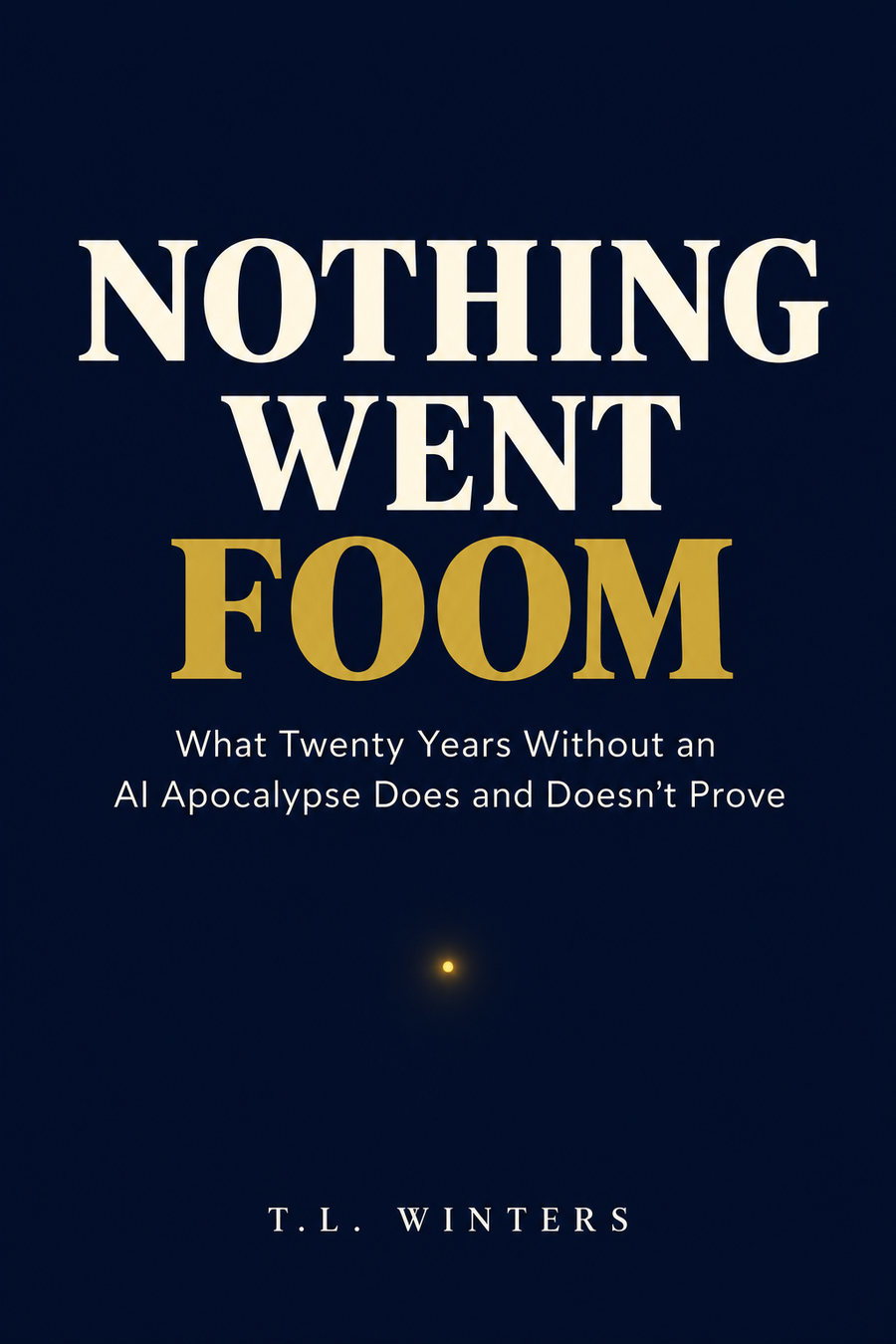
NothingWentFoom
What Twenty Years Without an AI Apocalypse Does and Doesn't Prove
Available on Amazon in all three formats.
They said it would happen in a flash. Then nothing did.
For twenty years, some of the smartest people alive warned that the first truly powerful AI would "foom": wake up, improve itself, and leave us behind in a weekend. The prediction was not a joke, and it was not stupid. It was a serious argument, made by serious people, and it shaped billions of dollars, a dozen institutions, and an entire culture.
So what happened? The machines got better, fast. They write code, fold proteins, pass exams, and occasionally lose their minds on the front page of the newspaper. What they have not done is blow up the world, or come close to a sudden takeoff.
Nothing Went Foom is a friendly, clear-eyed tour of the biggest argument in technology. It looks at the old alarms that fizzled, the ones that held up, and the ones nobody has settled. It covers the paperclips, the shoggoth, the sharp left turn, the open letters, and the very real cost of slowing down when people are waiting on cures. Each side gets its best case. Then the book says plainly which parts of each have survived contact with reality.
No jargon. No doom. No cheerleading. The absence of a catastrophe is evidence. The question is of what.
The bridge and the train
Suppose someone predicts that a bridge will collapse under its own weight by Tuesday, and it is still standing on Wednesday. Their engineering was wrong. Now suppose someone predicts that a bridge will collapse when a fully loaded freight train crosses it, and no train has crossed yet. The bridge's survival tells you nothing.
Most of the serious arguments for AI catastrophe were of the second kind. They did not say that GPT-2 would kill us, or GPT-4, or any particular system. They said that a system capable of certain things (sustained autonomous action, strategic deception, rewriting itself at scale) would be extraordinarily dangerous, and that we were building toward such a system without knowing how to control it. Whether we have reached that point is a question about capabilities, not about the calendar. The train has not crossed. The bridge is still up. That fits both stories.
The optimist has a reply, and it is a good one. A prediction that no amount of time can falsify is not a prediction; it is a mood. If the threshold is always just ahead of the current system, and every non-event is explained away as "not yet," then the pessimist's position has become unfalsifiable, and unfalsifiable positions do not deserve to govern policy.
Six parts, twenty-six chapters
- Part I
The Argument and the Word
Where AI stands in 2026, and where "foom" came from.
- Part II
The Receipts
Starving by the eighties, Y2K, the model too dangerous to release, the flood that wasn't, and the benefits nobody can wave away.
- Part III
The Mythology
The shoggoth, the paperclips, the basilisk, Sydney, and the sharp left turn, checked against what has actually been built.
- Part IV
The Engineering
Orthogonality, chip shortages, agents that cheat, the race argument, and what a sensible safety program looks like.
- Part V
The Cost of Slowing Down
The mother in the waiting room, how to count both costs, and machines of loving grace.
- Part VI
Verdict
What the optimists get right, what the pessimists get right, and why the honest title needs one more word.
The book
- Author
- T.L. Winters
- Formats
- Kindle, paperback, hardcover
- Trim
- 6 × 9 in
- Length
- About 39,000 words
About the author
T.L. Winters is an Air Force veteran and the author of several independent nonfiction titles. He writes about technology, risk, and how people argue about both.
Also by T.L. Winters- Indifferent Optimizers
- Indistinguishable From Magic
- Knowing Isn't Enough
- Surface Area